





Best Ashwagandha Supplement: Root Extract Wins | 2026

Best overall: a standardized ashwagandha root extract capsule with a fully disclosed label. Best liquid option: Herbal Goodness Ashwagandha Extract. Best for an unextracted preparation: ashwagandha root powder. This 2026 guide compares preparation types so you can choose the best ashwagandha supplement without confusing convenience, concentration and clinical evidence.
- The best ashwagandha supplement discloses the plant part, serving amount, extraction details and quality testing.
- Herbal Goodness Ashwagandha Extract suits adults who prefer an organic root liquid over capsules.
- Standardized root extract capsules offer clearer comparisons with research when their formulation matches the studied preparation.
- Ashwagandha research suggests possible stress and sleep benefits, but findings do not establish results for every product.
- Avoid ashwagandha during pregnancy; review medications and health conditions with a qualified clinician before use.
Why this matters
Ashwagandha is Withania somnifera, a plant used in Ayurvedic traditions. A root powder, concentrated extract and gummy can all carry its name while delivering different preparations. The word ashwagandha alone does not tell you what is inside.
Herbal Goodness Ashwagandha Extract is best for adults who prefer an organic root liquid rather than capsules. Its ashwagandha root liquid extract is the specific product considered here; that recommendation concerns format, not proven superiority for stress or sleep.
For your 2026 shortlist, separate three questions: does the preparation fit your routine, does its label explain the contents, and does the evidence concern that same preparation? A convenient format does not automatically answer the other questions.
What makes the best ashwagandha supplement?
Use these criteria before comparing the options below:
- Plant identity: Look for Withania somnifera and an explicit statement of root, leaf or both. Do not treat different plant parts as interchangeable.
- Preparation: Distinguish whole-root powder from an extract. For extracts, look for extraction details rather than relying on a concentration slogan.
- Serving transparency: Check the amount per serving and the serving instructions. Bottle size and front-label numbers do not replace the Supplement Facts panel.
- Standardization: When a product states a withanolide percentage, read it alongside the extract amount and plant part. A higher percentage is not proof of better outcomes.
- Quality documentation: Ask for identity and contaminant testing tied to the product or batch. Organic describes production standards; it does not establish clinical effectiveness.
- Practical fit: Choose a format you can measure and tolerate, then review other ingredients and medication considerations.
The strongest 2026 buying decision is not simply the largest milligram figure. It is the preparation whose identity, serving and documentation you can actually evaluate.
Ashwagandha options at a glance
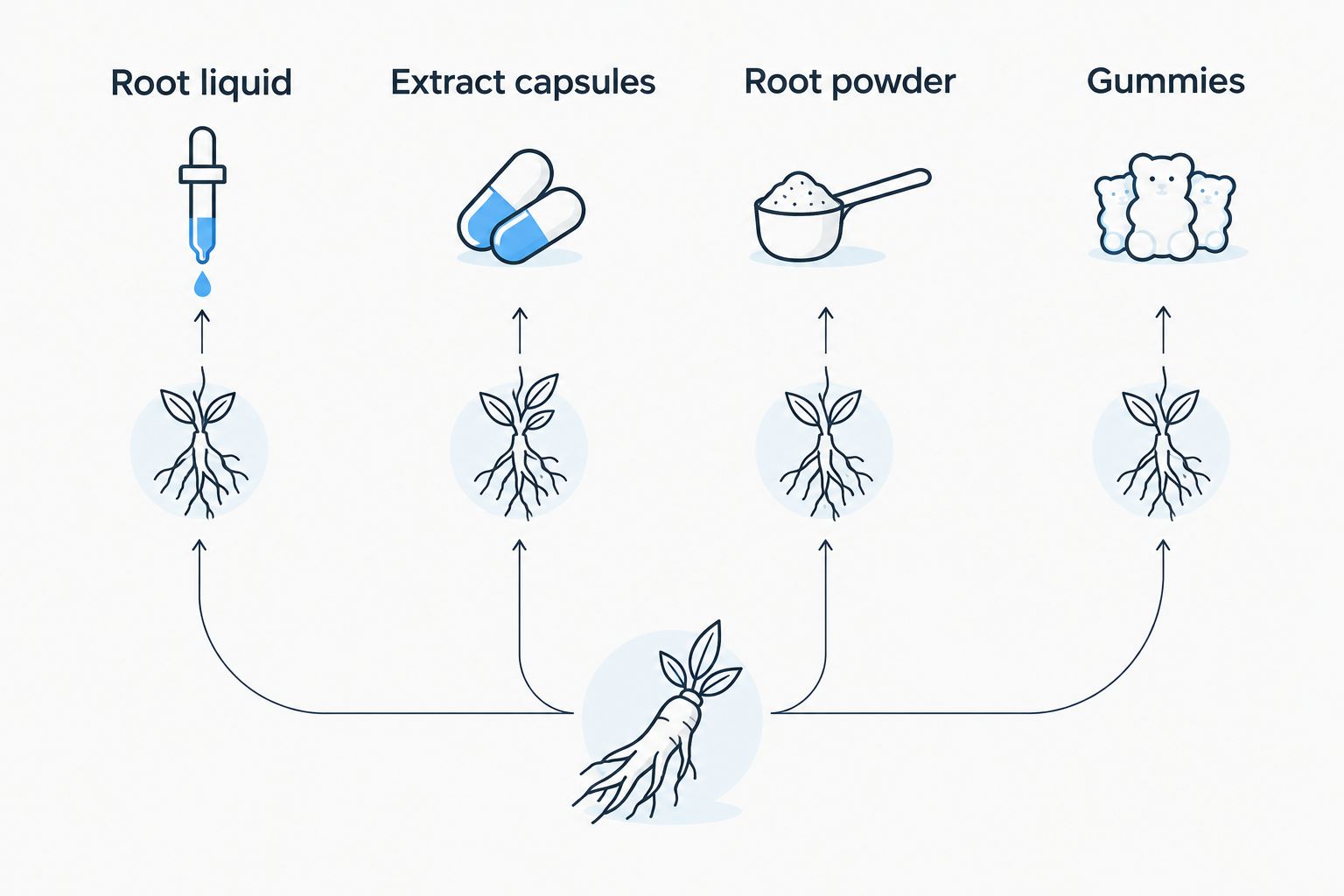
This ranking assigns each option a different job. The capsule category is the default for research-focused comparison; the liquid comes first below because it addresses a specific shopper preference and has an identified product to examine.
| Option | Best for | Standout feature | Key limitation |
|---|---|---|---|
| Herbal Goodness Ashwagandha Extract | Adults who prefer an organic root liquid | Named root preparation in liquid form | Clinical equivalence requires formulation details beyond the product name |
| Standardized root extract capsules | Comparing a supplement with published research | A disclosed extract amount and standardization can support comparison | Standardization alone does not prove a finished product works |
| Ashwagandha root powder | Choosing an unextracted preparation | Whole-root format for mixing into food or drinks | Powder servings are not interchangeable with extract servings |
| Ashwagandha gummies | Avoiding capsules and liquid droppers | Chewable format | Added ingredients and serving requirements need close review |
The table compares buying considerations, not results from head-to-head trials. No preparation earns a stronger health claim merely because it sits higher in the list.
1. Herbal Goodness Ashwagandha Extract: best for liquid users
Herbal Goodness identifies this product as an organic ashwagandha root liquid extract. It gives you a liquid option if swallowing capsules is not your preferred routine. That description establishes the plant part and format, not a particular clinical outcome.
Before choosing this ashwagandha supplement, inspect the current label for the serving amount, extraction details, other ingredients and directions. Do not infer alcohol content, withanolide standardization or equivalence to a studied extract from the word liquid.
Herbal Goodness Ashwagandha Extract pros:
- Identifies ashwagandha root rather than leaving the plant part unspecified.
- Provides a liquid alternative to capsules and gummies.
- Is described in the product inputs as organic.
Herbal Goodness Ashwagandha Extract cons:
- Liquid servings require careful measurement according to the label.
- The product name alone does not establish withanolide content.
- Research on another extract does not establish this product's effects.
Best for: Adults who specifically want an organic root liquid and will review its label before use.
Verdict: Buy for format fit only after checking the label and personal safety considerations. Do not choose it on the assumption that liquid absorption produces better stress or sleep outcomes.
2. Standardized root extract capsules: best for research comparison
A standardized root extract capsule identifies an extract and specifies a constituent level, commonly withanolides. When the label also gives the extract amount and plant part, you have a clearer starting point for comparing the formulation with published studies.
The capsule shell is not the source of the evidence. The relevant details are the preparation inside it, the population studied and the outcome measured. A different extract with a similar-looking number is not automatically equivalent.
Standardized root extract capsule pros:
- Offers a defined serving without measuring a liquid or loose powder.
- Can disclose both extract quantity and standardization.
- Makes formulation comparisons easier when the label identifies the studied extract.
- Avoids tasting loose root powder during use.
Standardized root extract capsule cons:
- A withanolide percentage does not establish finished-product effectiveness.
- Capsule size and other ingredients still affect suitability.
- Labels that omit extract identity leave important questions unanswered.
Best for: Adults who prioritize checking a formulation against research rather than choosing by flavor or format.
Verdict: Buy a clearly disclosed formulation; skip capsules that substitute strength claims for usable label details. This is the default category for an undecided shopper, not an endorsement of every standardized product.
3. Ashwagandha root powder: best for an unextracted preparation
Ashwagandha root powder is the ground plant material, rather than a concentrated extract. You can select this format when you want an unextracted preparation and are comfortable measuring it into food or a drink.
Root powder and extract are different materials. You cannot copy an extract serving from a study and apply it directly to powder, or assume that a larger powder weight creates the same exposure.
Ashwagandha root powder pros:
- Offers a straightforward whole-root preparation.
- Can fit a food or drink routine.
- Allows you to choose an option without a capsule shell.
Ashwagandha root powder cons:
- Requires measuring each serving according to the product directions.
- Taste and texture remain part of the experience.
- Evidence about concentrated extracts does not transfer automatically to powder.
Best for: Adults who deliberately prefer whole-root material over an extract.
Verdict: Buy for preparation preference, not as a presumed substitute for a studied extract. If research matching is your priority, a clearly identified extract is easier to assess.
4. Ashwagandha gummies: best for chewable convenience
Ashwagandha gummies provide a chewable supplement format. Their usefulness is practical: you avoid swallowing a capsule or measuring a liquid. The format itself does not establish stronger benefits.
Read the full serving instructions and ingredients. Compare the amount of ashwagandha per serving, not merely per gummy, and check whether the label identifies root powder, root extract or another preparation.
Ashwagandha gummy pros:
- Offers a chewable alternative to capsules.
- Does not require measuring loose powder or liquid.
- Can suit adults who dislike the other formats.
Ashwagandha gummy cons:
- Sweeteners, flavors and other ingredients require review.
- A serving can involve more than a single gummy; follow the actual label.
- Attractive flavor and packaging do not establish preparation quality.
Best for: Adults whose main obstacle is taking capsules or liquids, provided the gummy label remains transparent.
Verdict: Buy only when convenience and label clarity both fit; skip products that obscure the ashwagandha preparation. Keep chewable supplements away from children rather than treating them as ordinary sweets.
What the research supports—and what it does not
For this 2026 guide, the National Center for Complementary and Integrative Health's Ashwagandha fact sheet provides the main evidence and safety reference. NCCIH states that some preparations may help with insomnia and stress, while the evidence for anxiety remains unclear. These are qualified findings, not a promise that any supplement will produce the same result.
A 2021 systematic review and meta-analysis by Cheah and colleagues in PLOS ONE, Effect of Ashwagandha (Withania somnifera) extract on sleep, included 5 randomized controlled trials involving 400 adults. The analysis found a benefit for sleep outcomes, but its scope was the extracts and participants in those trials—not every liquid, powder or gummy sold under the plant's name.
Use that distinction when reading product claims:
- Traditional use explains why people have used a plant; it does not establish a modern product's effectiveness.
- An extract study concerns a particular preparation, serving schedule and population.
- A product claim needs support appropriate to that finished product or a justified formulation match.
Do not select an ashwagandha supplement as a replacement for evaluation of persistent sleep problems, distress or unexplained fatigue. The evidence does not support treating those concerns as a simple shopping decision.
Safety checks before you choose
NCCIH describes short-term use of ashwagandha as potentially safe for up to 3 months, while stating that long-term safety is not established. That is a limit on what is known—not a recommendation to take it for that duration.
For your 2026 decision, review the following before starting:
- Pregnancy and breastfeeding: NCCIH advises avoiding ashwagandha during pregnancy and not using it while breastfeeding.
- Thyroid or autoimmune conditions: NCCIH does not recommend it for people with these conditions.
- Surgery: Discuss use with your surgical team; NCCIH does not recommend ashwagandha around planned surgery.
- Medicines: Review potential interactions, including medicines for blood pressure, diabetes or thyroid conditions, immunosuppressants, sedatives and anticonvulsants.
- Adverse effects: Drowsiness, stomach upset, diarrhea and vomiting have been reported. Rare cases of liver injury have also been linked to ashwagandha supplements.
If you develop a concerning reaction, stop taking the supplement and seek medical advice. Do not dismiss symptoms because the product is herbal or organic.
How these options are ranked
The ranking uses preparation transparency, research comparability, quality documentation and practical fit. It does not claim laboratory testing, personal trials or a head-to-head performance comparison.
Standardized capsules are the default for evidence-focused comparison when the formulation is disclosed. The named liquid is the choice for liquid preference; powder serves whole-root preference; gummies serve chewable convenience. These are distinct use cases, not interchangeable claims of effectiveness.
Retailers and health practitioners can use the same checklist when assessing an assortment: request current labels, batch documentation and support for product claims. For trade interest in the brand, ask about its wholesale application rather than assuming retail descriptions answer professional sourcing questions.
Which ashwagandha supplement should you choose?
Choose a clearly identified standardized root extract capsule if you have no format preference and want the easiest starting point for research comparison. Choose the named organic root liquid when liquid use is your priority, or root powder when you specifically want an unextracted preparation.
In 2026, the best label is more useful than the loudest strength claim. If you cannot identify the plant part, preparation and amount per serving, leave that option off your shortlist.
FAQ
What's the best ashwagandha supplement in 2026?
A clearly identified standardized root extract is the default choice for comparing a supplement with published research. Herbal Goodness Ashwagandha Extract is the liquid-format choice for adults who prefer an organic root preparation. Personal safety and label details come before format preference.
Is liquid ashwagandha better than capsules?
Liquid ashwagandha is not automatically better than capsules. Compare the plant part, extract identity, amount per serving and supporting evidence; the format alone does not establish better outcomes.
Does ashwagandha help with stress or sleep?
Some ashwagandha preparations have evidence suggesting benefits for stress and sleep, according to NCCIH. Findings concern particular preparations and studies, so they do not establish the same result for every supplement.
Is ashwagandha root powder the same as root extract?
Ashwagandha root powder is not the same as root extract. Powder is ground plant material, while an extract is a different preparation; serving amounts and research findings are not directly interchangeable.
Should I choose the highest withanolide percentage?
The highest withanolide percentage is not automatically the best choice. Read standardization alongside the plant part, extract amount, formulation identity and evidence rather than treating one number as a quality verdict.
Who should avoid ashwagandha?
NCCIH advises avoiding ashwagandha during pregnancy and not using it while breastfeeding. People with thyroid or autoimmune conditions, planned surgery or potentially interacting medicines should discuss suitability with a qualified clinician.
Can I take ashwagandha long term?
Long-term ashwagandha safety is not established, according to NCCIH. Its fact sheet describes potentially safe short-term use up to 3 months, which is not a recommendation for indefinite use.
Does organic ashwagandha mean it works better?
Organic status does not establish that an ashwagandha supplement works better. Evaluate preparation identity, serving transparency, testing and relevant research separately from organic production claims.
One last thing
Before buying, save the Supplement Facts panel and the directions—not just the front of the bottle. Those details let you compare formulations accurately and give your clinician something useful to review. A strength slogan cannot do that job.
Related guides
Share this

Popular posts


FAQs
1. What are the main benefits of drinking bamboo leaf tea?
Drinking bamboo leaf tea supports hydration, relaxation, skin wellness, and antioxidant balance.
2. What is bamboo leaf extract used for?
It’s used for general body wellness, skin elasticity, hair and nail support, and overall vitality.
3. Can bamboo leaf help with skin care and body wellness?
Yes, bamboo leaf is rich in silica and antioxidants, which promote healthy skin, strong nails, and a youthful glow.
4. What forms of bamboo leaf are available?
You can find dried bamboo leaf, powder, extract, drops, oil, and bamboo leaf green tea.
5. Are there any side effects of bamboo leaf?
Bamboo leaf is generally safe when consumed in moderation. Always consult your healthcare provider before starting any new herbal supplement.