





How long does ashwagandha take to work?

Ashwagandha has no established day when it starts working; human studies generally assess changes after several weeks of regular use, not after a single dose. Research on stress and sleep supports setting a review point with your clinician rather than expecting immediate relief. Feeling sleepy after taking it is not proof that it is improving your stress response or sleep quality.
- How long does ashwagandha take to work? Clinical studies measure changes over weeks, not an established countdown.
- NIH guidance distinguishes promising stress and sleep research from proven benefits for every preparation.
- Herbal Goodness offers a root liquid; capsule research does not establish that liquid’s onset.
- Review medication interactions and safety before starting, and track one clearly defined goal.
How long does ashwagandha take to work?
There is no reliable universal onset time. A study’s final assessment tells you when researchers measured an outcome—not the first day participants noticed a change. That distinction matters when a product promises results on a precise schedule.
The following published studies provide useful reference points for this 2026 guide. They do not establish a deadline for your own response or validate every ashwagandha product.
| Research reference | Preparation and study period | What the timing tells you | Main limitation |
|---|---|---|---|
| Chandrasekhar and colleagues, 2012, randomized trial in adults reporting stress | Root extract capsules, 300 mg twice daily for 60 days | Researchers assessed stress-related outcomes after sustained use | The endpoint does not establish the first effective day |
| Langade and colleagues, 2019, randomized trial in adults with insomnia | Root extract capsules, 300 mg twice daily for 10 weeks | Sleep outcomes were evaluated across a course of regular use | Results from this preparation cannot establish another product’s onset |
| Cheah and colleagues, 2021, systematic review and meta-analysis of sleep trials | Five randomized trials involving 400 participants | Pooled findings suggest possible sleep benefits across studied preparations | Small studies and different preparations limit generalization |
These are research doses, not instructions for self-dosing. Your product’s label, medical history and medication review determine whether taking it is appropriate.
For preparation-selection questions, the ashwagandha supplement guide provides a separate starting point. Timing still requires evidence for the actual preparation, not just the plant name.
Why this matters
A promised onset date can push you toward the wrong decision: increasing your serving too soon, overlooking side effects, or continuing a supplement without a meaningful benefit. A more useful question is whether the preparation has relevant evidence and whether your own goal is changing.
In 2026, distinguish three things before buying: traditional use, findings from human trials and claims about a particular bottle. Ashwagandha’s history in Ayurveda explains why people use it; that history does not prove a specific onset, dose or result.
The National Institutes of Health Office of Dietary Supplements describes research on stress and sleep as promising while identifying limitations in the evidence. The National Center for Complementary and Integrative Health also emphasizes safety concerns and uncertainty about long-term use.
Stress support: research measures changes over weeks
Stress research does not establish an immediate, predictable calming effect. The 2012 Chandrasekhar trial used a particular root extract over 60 days and reported improvements in measured stress outcomes compared with placebo.
That finding supports further study of that preparation. It does not show that every root powder, tea, capsule or liquid produces the same result—or that everyone needs the same amount of time.
For your own assessment, define what improvement means before starting. A useful goal is specific enough to recognize, such as feeling less overwhelmed during an otherwise comparable workday. A vague goal like feeling better makes it difficult to separate a supplement’s effect from changes in workload, sleep or expectations.
Do not use ashwagandha to postpone medical care for persistent distress. A supplement trial and an assessment of ongoing symptoms are different decisions.
Sleep support: study duration is not an onset promise
The 2021 Cheah systematic review found a small overall improvement in sleep outcomes across the included trials. Benefits appeared more pronounced in some subgroups, including studies lasting at least eight weeks, but that does not establish eight weeks as a required waiting period.
The 2019 Langade trial followed participants for 10 weeks. Its findings apply to the tested extract and study population; they do not prove that an unstudied liquid or tea works on the same schedule.
Track the outcome you actually want. Falling asleep more easily, waking less often and functioning better the next day are different observations. Drowsiness alone does not demonstrate better-quality sleep.
If you have persistent sleep problems, seek a clinical assessment rather than repeatedly extending a supplement experiment. A longer trial is not automatically a better trial.
Why ashwagandha’s timeline varies
A useful 2026 buying decision starts with the preparation and the evidence, not a countdown printed in promotional copy. These factors explain why one study cannot supply a universal answer:
- Plant part: Root-only preparations and preparations containing root and leaf are not automatically interchangeable. Check which material the label identifies.
- Extract composition: Extraction and standardization affect what a serving contains. Matching a capsule’s total weight does not necessarily match its composition.
- Outcome measured: A stress questionnaire, a sleep assessment and a report of daytime alertness measure different things. Improvement in one does not prove improvement in another.
- Study population: Findings in adults reporting stress do not automatically apply to children, pregnant people or people with different health conditions.
- Use pattern: Trials follow defined protocols. Irregular use or changing preparations makes your experience harder to compare with that evidence.
- Changes in daily life: Work demands, caffeine habits, medications and sleep schedules can change how you feel. Record those changes rather than assigning every improvement to the supplement.
None of these factors justifies taking more than the label directs. A stronger-looking number on a bottle is not a proven shortcut to faster results.
Does liquid ashwagandha work faster than capsules?
There is not enough direct comparative evidence to promise that liquid ashwagandha produces faster stress or sleep benefits than capsules. A format’s convenience and its clinical onset are separate questions.
Herbal Goodness offers an ashwagandha root liquid, but the capsule studies discussed above do not establish that product’s onset. Choose the format around clear labeling and practical use—not an unsupported speed claim.
| Preparation | Best for | Practical advantage | Limitation |
|---|---|---|---|
| Ashwagandha Extract Root Liquid | Adults who prefer a liquid format, after a safety review | Provides an alternative to swallowing capsules | The cited capsule trials do not establish this liquid’s timing |
| Ashwagandha capsules | Adults who prefer a premeasured format | A capsule provides a defined serving format | Different extracts and strengths are not interchangeable |
Herbal Goodness ashwagandha root liquid is best for shoppers who prefer a liquid preparation, not those seeking a proven faster onset. That is a format recommendation, not a claim that it outperforms another preparation.
Organic labeling also does not establish onset or clinical effectiveness. Keep quality preferences separate from evidence about a particular health outcome.
How should you assess whether ashwagandha is helping?
Use a simple observation plan rather than repeatedly checking how you feel after each serving. For a 2026 supplement review, keep the goal narrow enough that you and your clinician can discuss a clear result.
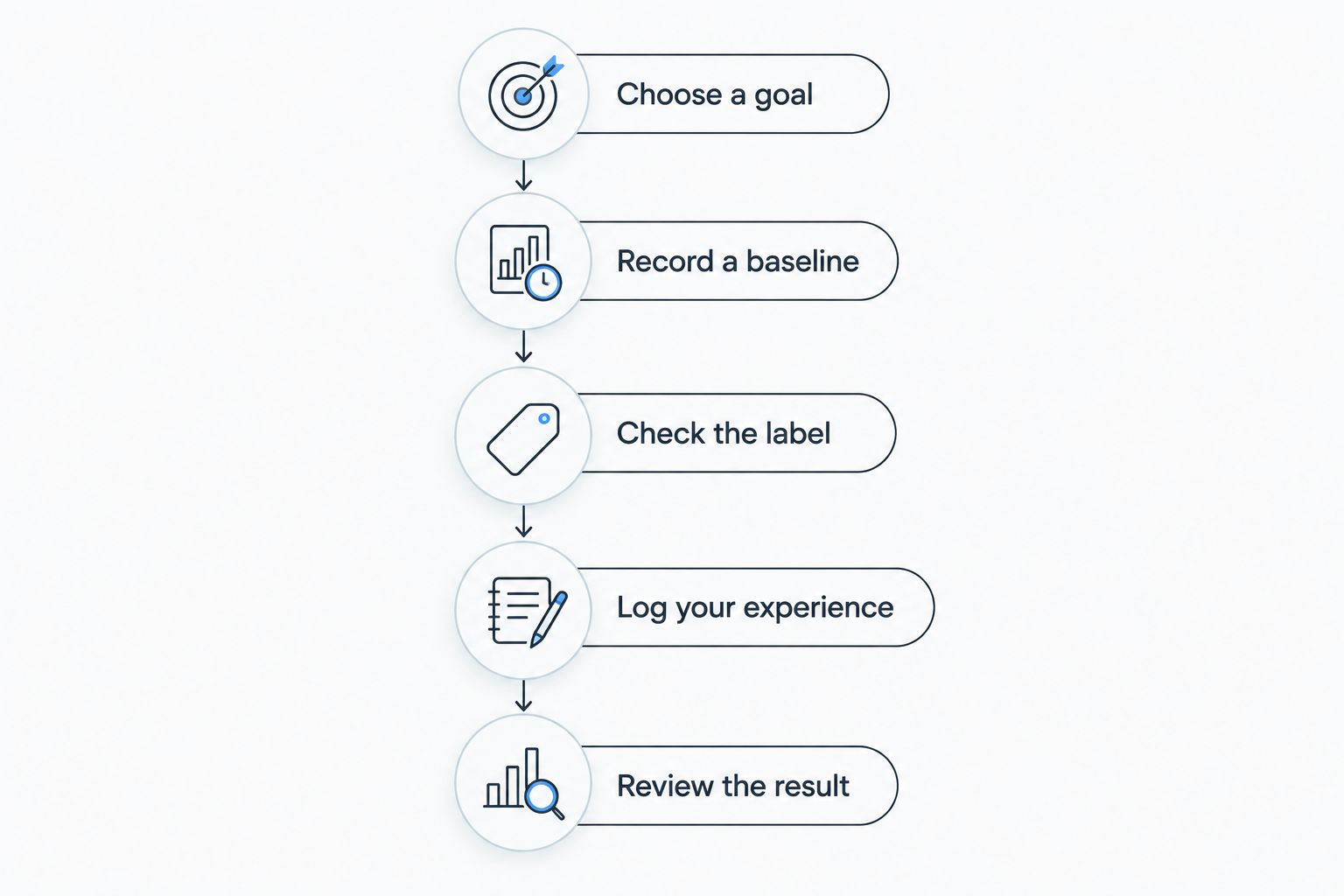
- Choose a goal. Write down the specific change you want to assess. Do not combine stress, sleep, energy and concentration into a single success measure.
- Record a baseline. Describe your usual pattern before introducing the supplement. Include the daily circumstances that affect that pattern.
- Check the label. Record the plant part, preparation, serving directions and other ingredients. Keep the bottle information so you can identify exactly what you used.
- Log your experience. Note use, the outcome you selected and any unwanted effects. Include changes in medications, caffeine or daily routine.
- Review the result. Agree on a review point with your clinician. Continue only after considering meaningful benefit, tolerability and the uncertainty around longer-term use.
Avoid introducing several new herbal products at once when your aim is to understand one preparation. Multiple simultaneous changes make it harder to identify what helped or what caused an unwanted effect.
If you miss a serving, follow the product’s directions rather than doubling up to catch up. Consistency is a way to make observations interpretable; it is not a reason to ignore discomfort or warning signs.
Who should avoid ashwagandha or get medical advice first?
Safety comes before completing a trial period. NCCIH advises avoiding ashwagandha during pregnancy and breastfeeding and identifies concerns for people with thyroid or autoimmune disorders and those approaching surgery.
Ashwagandha can interact with medicines, including sedatives, thyroid hormone, immunosuppressants and medicines used for blood pressure or diabetes. A pharmacist or clinician should review your actual medication list; the word natural does not resolve an interaction risk.
Reported adverse effects include stomach upset, diarrhea, vomiting and drowsiness. Rare cases of liver injury have also been reported. Stop use and seek prompt medical advice if you develop yellowing skin or eyes, dark urine or other concerning symptoms.
NCCIH describes short-term use of up to three months as potentially safe for some people, while longer-term safety remains uncertain. That is a safety-evidence boundary—not a recommendation to take ashwagandha for three months or to continue until a benefit appears.
For retailers and health practitioners evaluating Herbal Goodness, keep educational material equally precise: identify the preparation, distinguish study findings from product claims and avoid promising a response date. Product selection does not replace an individualized safety assessment.
Should you keep taking ashwagandha if you notice nothing?
No noticeable benefit is a reason to review the decision, not automatically increase the serving. Check whether you had a defined goal, used the same preparation consistently and changed other parts of your routine.
Then discuss whether continued use makes sense. A study that lasted 60 days does not prove that everyone who feels no difference before that endpoint should continue, and a 10-week study does not establish indefinite use as beneficial.
If your original concern remains significant, pursue appropriate care. Do not turn a research timeline into a reason to tolerate ongoing symptoms or side effects.
FAQ
Can ashwagandha work the first day?
A first-day sensation does not establish a sustained stress or sleep benefit. Published trials generally evaluate repeated use, and drowsiness can be an adverse effect rather than evidence of improved sleep.
How long should I take ashwagandha before reviewing the results?
Agree on a review point with your clinician rather than following a universal countdown. Research includes a 60-day stress trial and a 10-week sleep trial, but those durations are not personal dosing instructions.
Does liquid ashwagandha work faster than capsules?
Direct comparative evidence does not establish a faster onset for liquid ashwagandha. Choose a preparation by its labeling, relevant evidence and suitability, not a speed claim.
Should I take more ashwagandha if I do not feel anything?
Do not increase your serving simply because you have not noticed an effect. Follow the label and review the goal, preparation and safety considerations with a clinician.
Is feeling sleepy proof that ashwagandha is working?
Sleepiness is not proof that ashwagandha is improving sleep quality or stress. Drowsiness is a reported adverse effect and deserves particular attention if you use sedating medicines.
Can I take ashwagandha every day indefinitely?
Long-term daily use is not established as safe. NCCIH describes limited short-term safety information and uncertainty about longer-term use, so review continued use with a clinician.
Can I take ashwagandha with my medication?
Ask a pharmacist or clinician to check your medication list before taking ashwagandha. Potential interactions include sedatives, thyroid hormone, immunosuppressants and medicines for blood pressure or diabetes.
One last thing
The most useful number in a study is not always its duration. Check whether the researchers tested the same preparation and measured the same outcome you care about. A precise timeline attached to the wrong extract answers the wrong question.
Keep that distinction at the center of your 2026 decision. Before your next purchase, write down the outcome you want and the evidence that would justify continuing; a bottle’s format or plant name cannot supply that answer alone.